
-

Staff Duress System Workers’ Comp Savings: CFO Guide
Key Takeaways Violence-related claims are driving your workers’ comp premiums, but the data that proves it lives in three places: claims with HR, incident reports with your CNO, and the MOD score calculation with your broker. Nobody connects them until renewal season, when the number is already baked. A staff duress system closes that gap,…
-

Nurse Duress and Turnover Costs in Behavioral Health
Replacing one bedside RN costs $61,110 on average, but behavioral health facilities face longer vacancies, higher agency rates, and specialized training that push the actual cost past $100,000 per departure
-
Staff Duress Solution for Behavioral Health | 2026
Key Takeaways Your board chair asks what peer facilities are doing about workplace violence. Your CNO is requesting more resources. Your CFO is flagging a workers’ comp trend that keeps climbing. You need an answer that satisfies all three, and you need it backed by evidence, not assumptions. Behavioral health settings face the highest workplace…
-
Workplace Violence Technology for Behavioral Health
Key Takeaways Your nurses face violence at nearly twelve times the rate of their counterparts in general medical settings. Most of those incidents never get reported. The staffing plans, budget requests, and safety decisions you make every day rest on a sliver of what actually happens on your units. Workplace violence technology for behavioral health…
-

Staff Safety in Psychiatric Hospitals: Complete Guide
Key Takeaways Your vacancy dashboard shows behavioral health nursing turnover at 22.8%, the highest of any specialty in your system [1]. Exit interviews keep surfacing “safety concerns” as a contributing factor. But when you cross-reference incident reports, the numbers look stable. That gap between what exit interviews say and what incident data shows is a…
-

Bluetooth Panic Button Guide: WiFi-Free Safety Systems
Key Takeaways The locations flagged as highest-risk on incident reports overlap almost perfectly with the locations flagged as dead zones on RF heat maps. Stairwells. Courtyards. Parking lots. Transition corridors between locked units. In behavioral health facilities, the construction that keeps patients safe is the same construction that blocks wireless signals. That overlap is the…
-

Staff Duress Deployment: Joint Commission Survey Guide
Key Takeaways Accreditation surveys expose a gap most behavioral health leaders don’t see coming. Your violence prevention program may be thorough. Your staff may be well-trained. Your protocols may work. But if you can’t hand a surveyor documented proof of all three, none of it counts. Staff duress deployment that generates continuous evidence is what…
-

Behavioral Health Workplace Violence: Why Unions Organize Around Safety First
Key Takeaways Union organizing campaigns in behavioral health don’t lead with wages anymore. They lead with safety. When nearly half of nurses say their employers ignore workplace violence incidents after they’re reported [1], organizers have something better than a pay grievance. They have a story that unites every worker in the building, from housekeeping to…
-
4-Hour Power Outage. Zero Downtime. What Standalone Safety Architecture Actually Looks Like
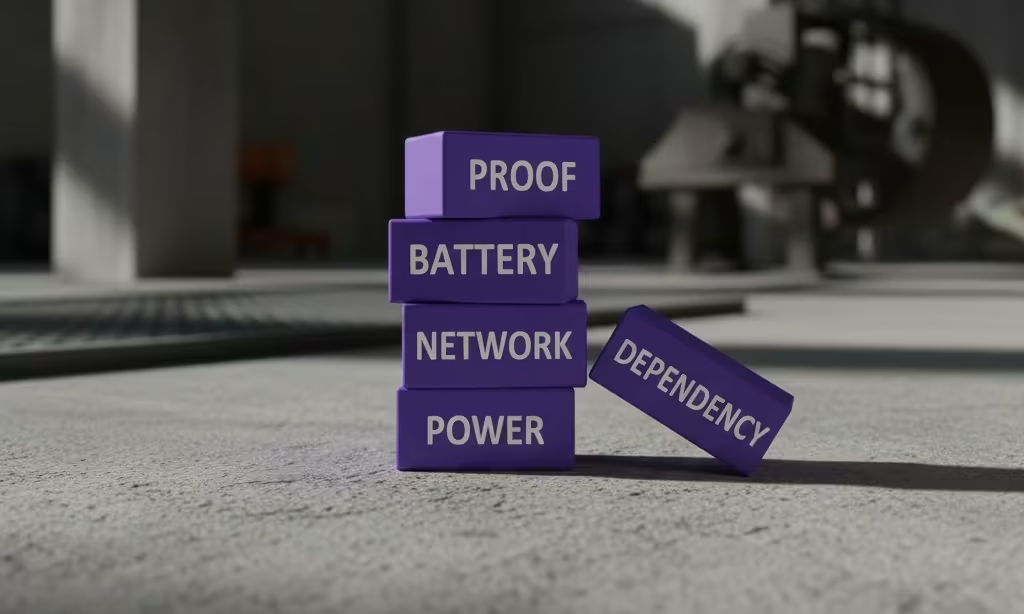
Key Takeaways During a 4-hour power outage at a Pennsylvania health system, the staff duress infrastructure continued operating without interruption. No coverage gaps. No manual workarounds. No scramble to protect staff in the dark. That outcome was architectural, not accidental. And it exposes a vulnerability most CTOs have never evaluated in their current safety systems.…

