
Your workforce is everywhere. Your safety system should be, too.
One standard of protection. Zero dead zones. Zero IT burden. Deployed the same way across a flagship hospital, a satellite clinic, a select-service hotel, and a university campus — because the people doing the work don’t get to choose which building is safe.
With ROAR, a worker can call for help the instant something feels wrong. One press, no phone, no app, no signal required, and the right people are moving toward her in seconds. In the stairwell. The parking garage. The basement. The room with no signal. Every time.

What the people signing the contract say.
The lowest-burden safety system you can deploy.
Protection that asks almost nothing of the people who run it, and everything of itself when it matters. See how ROAR’s duress solution is different.
Easiest to adopt
No wiring. No network integration. No IT project that drags on for quarters. ROAR installs without touching your infrastructure, which means protection that’s live in days, not a line item that lives on IT’s roadmap forever.
Easiest to do business with
From the first conversation to contracts, installation, training, and ongoing drills, ROAR is built to be simple to work with. We provide the staff training and the practice drills. We handle the install and the upkeep. The relationship is designed so that adding protection never becomes another thing for your team to manage.
We take care of everything
White-glove isn’t an upgrade tier at ROAR, it’s the standard. Unlimited training, 24/7 support, full maintenance, and a team that stays with you after go-live. Your staff wear the device. We carry everything behind it.
It does one thing, completely
ROAR is duress, and only duress. We don’t fold safety into a platform that also does access control, analytics, and a dozen other jobs. Would you want a fire alarm that also ran the thermostat? The most important system in the building should do one thing, and do it without fail.
How ROAR compares
Feature-by-feature, across the approaches most organizations have already considered.
| ROAR | Wi-Fi panic systems | Smartphone apps | Guards + code phrase | |
| Dead zones | None, mesh is self-contained | Wherever Wi-Fi drops | Wherever cell signal drops | Wherever the guard isn’t |
| Cyberattack survival | Unaffected, fully off network | Offline when network goes down | Offline when network goes down | Unaffected but slow |
| Power loss coverage | Battery-backed system remains online | Depends on UPS coverage | Device-dependent | Unaffected but manual |
| Location accuracy | Room-level, every time | Zone or floor at best | GPS outdoors only | None |
| IT footprint | Zero, no integration required | Heavy, tied to IT network | Moderate, MDM required | None |
| Multi-site consistency | Identical across all sites | Varies by network config | App version dependent | Highly variable |
| Mandate compliance | Built in, audit-ready | Partial, varies by system | Rarely qualifies | Rarely qualifies |
| Silent operation | Yes, silent and discrete | Varies | Silent, but less discrete | No, verbal required |
| Surveillance risk | None, no data collected | Location logs retained | Movement data tracked | None |
You’ve probably tried at least one of these. Here’s why they fall short.
Most organizations don’t arrive at ROAR without a history. They’ve tried something, or several things. Here’s what each approach gets wrong.
The status quo:
hope and a radio
Staff report incidents when they can reach someone, and security responds when they hear about it. There’s no real-time alert and no reliable record — just a culture of hoping nothing escalates.
Smartphone apps:
the device that isn’t there
They assume staff have their phone, have a cellular signal, and can unlock and navigate to the right button under stress — a chain that breaks in a laundry room, a patient room, or a parking structure. They also require MDM enrollment and ongoing IT management, creating friction before they’re ever used.
Wi-Fi panic systems:
only as reliable as your network
If your safety system lives on your IT infrastructure, it fails when that infrastructure fails — an outage, a ransomware attack, or a dead zone in a concrete stairwell. And they demand wiring, integration, and ongoing maintenance, which keeps your safety program permanently on IT’s project list.
Self-contained mesh: almost right
Most mesh systems fall short on execution: heavy hardware to install, no room-level accuracy, and no clean way to scale across sites. Closing that gap is what separates ROAR.
From the field
Our prior system covered the lobby. ROAR covers the parking lot at 11 PM. That’s not a minor upgrade — that’s a completely different level of protection for the people who close.
Director of Security, Full-service hotel, multi-property operator
Three stakeholders.
One proposal that answers all of them.
ROAR doesn’t require a different story for each room in the building. The same system answers the questions that security, HR, and finance are each going to ask.
For Security and Public Safety
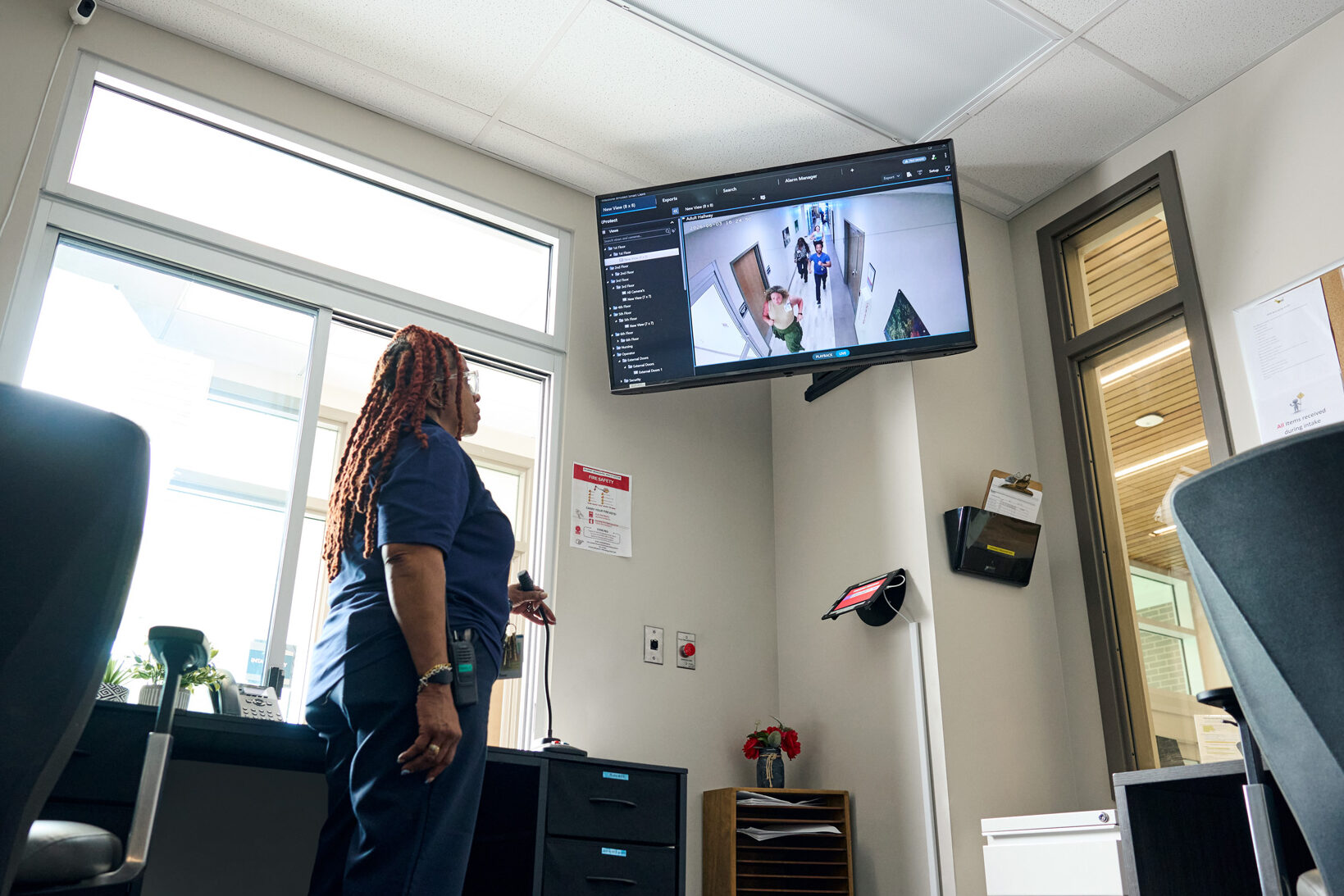
A program that actually works where your staff work. Room-level location accuracy means responders go to the right place — not the right floor. Coverage that doesn’t drop in stairwells, parking structures, basements, or any space your team actually occupies. Incident logs that generate automatically, without relying on staff to remember to file a report under stress. And a system that stays up when your network doesn’t.

For HR and People Operations
Something your staff will actually wear. ROAR collects no GPS data, no audio, no movement history — which means it clears the union table and earns genuine trust from the people using it. Staff who feel protected stay longer. Organizations that can prove their commitment to safety recruit better. ROAR gives you a concrete benefit to put in job descriptions and a retention argument that holds up in exit interviews.

For Finance and Risk
Duty of care, quantified. Automatic incident documentation that holds up in litigation. Workers’ comp trajectory that responds to reduced incident rates — one ROAR customer reduced their Experience Mod by approximately 50%, their lowest rate since 2015. Compliance with state and local mandates built in, not billed separately. And a single vendor, single contract, single line item that covers every property in your portfolio.
Which seat are you in?
The same system answers differently depending on who’s asking. Find your perspective — each page is written for your priorities, your metrics, and the questions you’ll need answered before this goes to a vote.
Chief Executive Officer
Strategic risk, board accountability, and the peer question: what are other facilities doing?
Chief Nursing Officer
Staff sentiment, incident patterns, and the retention case for a safety investment.
Chief Medical Officer
Clinical risk, patient safety overlap, and the duty-of-care framework.
Chief Human Resources Officer
Turnover data, union considerations, and why staff trust matters more than the device.
Chief Technology Officer / IT
Zero network integration, 99.9% uptime, HIPAA compliance, and two-day deployment.
Chief Financial Officer
Workers’ comp trajectory, Experience Mod, duty-of-care documentation, and ROI.
Built from lived experience. A decade before the mandates.
ROAR was founded by Yasmine Mustafa, whose commitment to frontline worker safety predates the legislative momentum that has since made it a compliance requirement. The company is a Certified B Corp — which means the mission to protect workers isn’t a marketing position, it’s written into the corporate bylaws. Profit doesn’t override purpose. It never has.
ROAR is a National Accelerator Foundation preferred vendor — a recognition that reflects both the quality of the technology and the values behind it. The team has been in rooms that most safety vendors have never visited: break rooms, housekeeping closets, nursing stations, the back of a hotel laundry where someone is working alone at midnight. That proximity is what makes the product different.
The mandates caught up. The lobbying caught up. The industry attention caught up. ROAR was already there.

Yasmine Mustafa, President & Founder